Foreword
[Placeholder. Foreword by Aaron Burnett, to come.]
Aaron Burnett
Preface
Everyone knows that we are going through a great civilizational change. You see it in the headlines, at work and at the dinner table. Not everyone has the words for it, or an understanding of some of the technologies, but everyone is very much affected. The public discourse is about massive job loss, and people are already losing their jobs to AI. Bias, military uses and regulation are discussed as well, and all of these are symptoms. There is a global, systemic concern about what is happening. People sense the transition, but they do not grasp how big it is.
People compare it to electricity, the internet and the Industrial Revolution. We are at the largest civilizational transition in the history of humans. We have never been through a transition in which one of the coordinating factors was made nearly unlimited. That is the difference. Through all of the earlier ones humans stayed the thinking species, and we could always open the box and trace the logic inside. We are not having disruption here, evolution here and revolution there.
I have been curious about thinking for as long as I can remember, long before I had heard of metacognition, or of cognition for that matter.
Before I could read, I took things apart. I took apart electronics, appliances, car parts and anything else I could get my hands on. I rarely put them back together, because there was always something else to disassemble. While other kids played sports, I fashioned my closet into an Apollo capsule. I built a robot from an old wringer washing tub. I was reverse engineering the world, trying to understand how systems worked from the inside.
As a young child I did not like school. It was not interesting at all. I started doing well in grade ten, because I knew I needed good grades to take engineering. My high school had some vocational classes, which were frowned upon, but I took electronics and loved it.
The first book that mattered to me was Jonathan Livingston Seagull by Richard Bach [Bach 1970]. I was eight years old. It was made into a film, with music by Neil Diamond in the background. It is about a seagull called Jonathan Livingston and his dealings with his flock, and how disappointed he was in them for picking at garbage all day while he tried to learn to fly faster and better and more efficiently. None of his flock were interested, and they thought he was stupid. Jonathan reminded me of myself. I was never looking for perfection, but I always seemed to be doing something different from what other people were doing. Reading was the only channel I had for finding new ideas.
I read Bertrand Russell when I was quite young, at twelve. I would not call myself a contrarian, but I did not believe much of what people told me. It was not that I thought they were lying. I had noticed from a young age that people did not have much interest in facts. I was not big on religion either, knowing that there are billions of planets in the universe. So when I saw his book Why I Am Not a Christian [Russell 1957], I thought it would be interesting to read, and that it would give me a good, articulate case to put to adults about why I was not a Christian. What I learned then, and over the long term, is that everybody has beliefs, that people arrive at them in all kinds of ways and for different reasons, and that you cannot assume too much.
What surprised me in it was the debate Russell had on the BBC in 1948 with Father Frederick Copleston, a Jesuit philosopher. I had thought he would be naive, with a lot of dogma and not much rationale. On the contrary, he was very smart and very rational, and the debate was very enjoyable to follow. He argued from Leibniz’s principle of sufficient reason. The lesson for me was that the other side has arguments too.
Gödel, Escher, Bach by Douglas Hofstadter [Hofstadter 1979] caught me by its title first. I play guitar and I make acoustic guitars, I paint, and I love mathematics and physics, and I did even then. When I read it, the braid of all those different things was fascinating. Hofstadter showed me that meaning can come out of self-reference, loops that give rise to a mind. At university I read James Gleick’s Chaos [Gleick 1987] and Roger Penrose’s The Emperor’s New Mind [Penrose 1989]. Gleick showed that simple rules produce complexity nobody can predict, and Penrose argued that the mind does something no algorithm can do. Those three books marked out the limits of formal reason for me.
The Hitchhiker’s Guide to the Galaxy [Adams 1979] I read because it was fun, and Hawking’s A Brief History of Time [Hawking 1988] because it was precise. Kahlil Gibran’s The Prophet [Gibran 1923] came from the same place as Jonathan Livingston Seagull and Bertrand Russell, which was my early interest in psychology and philosophy. Adams taught me that the universe does not arrange itself around us. Hawking asked whether reality can be understood at all. Gibran taught me that wisdom and knowledge are different things.
Carver Mead came later. In 1989, going into my last year of university, I was in Toronto, walking past a bookstore, and I saw his book in the window. It was Analog VLSI and Neural Systems [Mead 1989], and it had a picture of a stylized neuron on top of a transistor. I was flabbergasted. I asked myself what it was, and I took it to my professor and told him this was something I wanted to do. The chips in that book computed the way neurons compute, and they used the noise in the transistor. Mead was one of the first people to think about AI and neural networks in silicon, and that was very important. He was telling me that intelligence is physical. I had never heard anybody say that energy, the material and the noise are the thing itself. That is how I became interested in neural networks.
I begged my professor to let me spend my final year studying neural networks. In 1989, using Mead’s principles, I first built an ADALINE neural network, the architecture Bernard Widrow had created, in discrete electronics. Then I used Cadence to design a 1.2 micron CMOS chip, a neuromorphic processor, built before the term was common. Mead's idea was that minds obey the same constraints as the physical world, and that you could build hardware that way. It was not abstract to me. I had held it in my hands. In 2025 I met Professor Mead at Caltech.
For my graduate research, I pushed further into artificial neural networks. My thesis was titled Reverse Software Engineering and Artificial Neural Networks. The child who disassembled appliances had found a way to disassemble code. I used Kohonen self-organizing feature maps to recognize objects in COBOL code that I had decomposed into tokens using lex and yacc, building an embedded representation of program semantics. I called the system SORT, the Software Reengineering Toolkit. The neural networks looked for patterns in the COBOL code so that it could be reverse engineered into object-oriented code. They were looking for language patterns in a programming language, in a way very similar to large language models, and this was in 1992.
In 1994, near the end of my graduate research, I published papers at the International Conference on Artificial Neural Networks in Sorrento, Italy, at the World Congress on Neural Networks in San Diego, and at the IEEE International Conference on Neural Networks in Orlando, which was part of the first IEEE World Congress on Computational Intelligence. The excitement in those rooms was palpable. All of us were sure we were building something that would change everything. After my graduate research, the neural network and AI field went very quiet. The conferences thinned and the funding dried up, and neural networks were dismissed as a dead end. The questions waited thirty years. I retreated into finance, made good money and did all kinds of interesting quantitative work.
My career in finance never really ended. I spent years in the corporate world of the big banks, and I was CIO at Bank of Montreal. In those institutions, what counts as innovation is all relative. They are banks, and big ones, and any risk they take has to be weighed in the context of regulation and of people’s money. That makes innovation very difficult. The change I wanted to be part of was deep tech at the bleeding edge, and those institutions and their leaders could not take that kind of risk.
It has only been in the last five years that I have returned to researching and implementing AI systems. Things have changed.
My first experience with the new AI was in 2020, when I looked at what everybody was hyping about large language models. There was consensus everywhere that the technology was interesting and powerful. I looked at it and concluded that it was a very large tensor structure doing pattern matching. That was interesting, but we had done it before, and I dismissed it as no big deal. Then I started using it. Immediately I knew that I did not understand it, and that it could not be what I thought it was. I reached out to senior academic colleagues and to people at some of the leading AI companies, and they told me that it was what I thought. I asked how that could be, and they said it was the scale. It took me a long time to get my head around that. Nobody can open one of these networks, with its billions of parameters, and trace how it reached a decision. That changes what it means to know something.
We founded Mach33 because we wanted to build a different kind of financial firm, one that knew what it invested in and could take part in it. AI and robotics are examples, along with semiconductors, quantum computing and advanced materials. We built a laboratory for deep, peer-reviewed research, where we get our hands dirty on AI code and on robots and learn the ins and outs. We hire people with experience in these fields. All of that lets us understand what we are investing in, and it has made us thought leaders and experts in the area.
What we want to offer is a framework that people can use to think about this dramatic change, and to find where they can enact change or where they should be in what is happening. My son is an example. He told me that he did not really like AI. I told him that it is happening whether he likes it or not, and that what he should do is find out what part of that world he wants to be in. It turned out that he was interested in the epistemic work we do on AI. That is what the framework is for. It gives a person a way in.
The book is for anyone who wants to understand this transition, or who wants a different view of it, from someone who thinks about it from the point of view of science and physics.
What is different now? Never in the history of humanity has one of our constraints, whether of abundance or of scarcity, been removed completely. With AI, cognition is now limitless. Tasks we never did because they were cognitively laborious, we now do without thinking about it. We set a coding agent to work and it codes all night. That reconstitutes our whole society and every one of its institutions.
Most of what people call AI today is a large language model. My prediction is that large language models will be five percent of what we use in the future. The power they already give humans is immeasurable. For all of history thinking was scarce. It lived in human heads, and there were only so many of them. Large language models make cognition abundant, if not limitless. No civilization has had that before, and it is forcing civilizational change of a kind we have never seen. The thing I have been curious about my whole life is now something we manufacture, something we create that then creates itself. Can we keep up?
J. Brant Arseneau
Founder, Mach33 Initiative
January 2026
Prologue: The Long Arc of Continuity
Expansion is a pattern throughout the physics of the universe. Things expand and collapse. Stars expand and then collapse under their own weight, and the universe itself is expanding. Human expansion is different because it is not pure physics. It is driven by humans, through complicated interconnections of primal forces, individual and collective. Civilizations have always lived inside those forces, long before anyone named them.
For most of ten thousand years the forces worked through the material world. Fire let people move to different climates, stay warm, cook their food and be healthier, and it took a long time to master. Hunter-gatherers found that moving around took a great deal of their energy, and that a field or an orchard, once harvested, was depleted and forced them to move on. By managing the land they could stay in one place and spend their energy on building a center, which became the hub of the first cities. Cities became city-states, city-states became interconnected, and civilization grew out of that. It grew independently in several places, among them the Nile Valley, the Mesopotamian Valley, the Indus Valley and the Yellow River Valley, all four of them river societies.
Information was as important as land. The Mesopotamians created cuneiform, one of the first ways of recording the written word. Written information stayed scarce for a long time, up until Gutenberg in the 1400s, and governments and monarchies could control people who did not have it. Ada Lovelace, far back in 1843, and Claude Shannon, in 1948, saw information very differently from other people [Lovelace 1843; Shannon 1948]. They saw it as something that could be manipulated and encoded. Since the printing press, and then the transistor and the microchip, information has gone from scarce to abundant.
Before AI we had an information age, in which information spread rapidly, and it still does. The good part of that was education, awareness, being in touch and expanding one’s horizons. It also became a tool for misinformation and coercion. When we say that knowledge moves faster than people can reflect on it, what moves faster is information. People need to reflect on it to decide whether it is knowledge.
Civilizations do not all handle a transition the same way, and two cases show the difference. The Meiji Restoration was the time when Emperor Meiji brought Japan back into a global market after more than two hundred years of seclusion. The leaders before him felt that the Western powers were trying to influence Japan too much and were taking too much from it, which in retrospect we know they did to many countries. It was an understandable decision at the time. Foreign traders could enter only one port, Nagasaki, and the rest of Japan was closed. The country became very insular. Its customs and culture became very cohesive, but little advancement came in from outside, and the Industrial Revolution was happening. Meiji saw this. It was a time when the samurai led the local communities, and the transition was huge. It was not smooth, and it was very disruptive. What is interesting is that Japan’s culture and traditions cohered.
Rome went the other way. It expanded too fast and too large, much of its communication and coordination was lost, and it became chaos. The grain was still crossing the Mediterranean while the empire came apart, but that was trailing infrastructure. It had been set up many years before the problems, and it kept trickling across during the fall. Then all of that infrastructure, both the real assets and the processes, was cut off and crumbled.
What separates the two is reflection. As a civilization expands, if it does not reflect on what has changed, it loses coherence. If humans do not reflect on those changes, the knowledge of them is lost, and the civilization keeps running on them without anyone knowing what they are. It then becomes dysfunctional, fragmented and confused. When a civilization fails, it has run out of meaning, not energy or knowledge.
Failure does not always end in total chaos. In terms of derivatives, the acceleration of expansion slows and sometimes turns negative, but customs persist. Many things from the Roman Empire and the Byzantine still exist. Archaeology and anthropology are how things are passed on from civilization to civilization, so the process is like climbing. Some setbacks are bigger. The Inca Empire vanished, and the rest of civilization got little value from it until it was found.
Now it is cognition, and AI is making it abundant. The more we rely on what we create, the less we understand it. Take away power and food for a few months. What percentage of the people on earth today would survive, compared with two or three hundred years ago? Humans have lost the ability to understand the elements of civilization as they have become more reliant on the things they created.
There is some public recognition that reflection will get harder and harder, and that the only way to do it is to be in control. That is why people who lead AI companies are asking for some regulation. Some of it is concern about AI safety, and some of it is competition. There is also a big tension in reflection, because the commercial capital world needs to move faster than reflection does. That is the very nature of capitalism, and it is the tension we need to look at.
Part I
Foundations The Ground Beneath the Question
Before we can understand where civilization is going, we must understand how it has thought about where it has been. The question of civilizational continuity is not new. Scribes in ruined Sumerian cities asked it. Greek philosophers debated it. Arab historians theorized it. Modern economists and cognitive scientists continue to refine it. Each generation of thinkers illuminated part of the puzzle: the fragility of external memory, the resistance to transformative knowledge, the erosion of cohesion through success, the costs hidden in paradigm shifts. Yet across five thousand years of inquiry, every major theorist shared a common assumption: that reflection could keep pace with expansion, that human understanding would stretch to accommodate whatever powers civilization developed. The cognitive transition now underway breaks this assumption. For the first time, we are building systems whose operation exceeds human interpretive capacity not temporarily but structurally. Understanding why this matters, and what might be done about it, requires first understanding the full arc of how humanity has thought about its own continuity. This part establishes that foundation. It traces the question of transition from its earliest articulations to its present urgency, revealing both the accumulated wisdom of predecessors and the unprecedented nature of the challenge we now face.
Chapter 1: Introduction
1.1 Why Do Civilizations Expand?
Every institution, every technology, every system we have will be reconstituted, because cognition is becoming abundant. We are at the largest civilizational transition in the history of humans. We have never been through a transition in which one of the instruments of coordination was made nearly unlimited. That is the difference. We are not having disruption here, evolution here and revolution there.
To understand that, we have to ask why civilizations expand. Most people do not ask, because people do not think about civilizations expanding. They think about markets expanding and population growing, but they do not see a living, breathing, interconnected civilization expanding. They do not think about what it means to expand. They think it is numbers, metrics of land and people. But it is about knowledge and coherence and empathy, and how we treat one another, and civil rights. It is much more than the material world.
Expansion costs the work it takes to fight entropy and to create coherence across civilizations. That is a lot of work, across a lot of different factions.
1.2 What the Work Attempts
Everyone knows that we are going through a great civilizational change. Not everyone has the words for it, or an understanding of some of the technologies, but everyone is very much affected. The public discourse is about massive job loss, and people are already losing their jobs to AI. There is a global, systemic concern about what is happening. The aim here is to put that change into a framework that makes more sense of it, one that highlights the risks and the opportunities so that people can understand it a little better, and in a different way.
The framework has four parts (Figure 1.3). They are the primal forces, the instruments of coordination, exchange, and the Principles of Expansion.
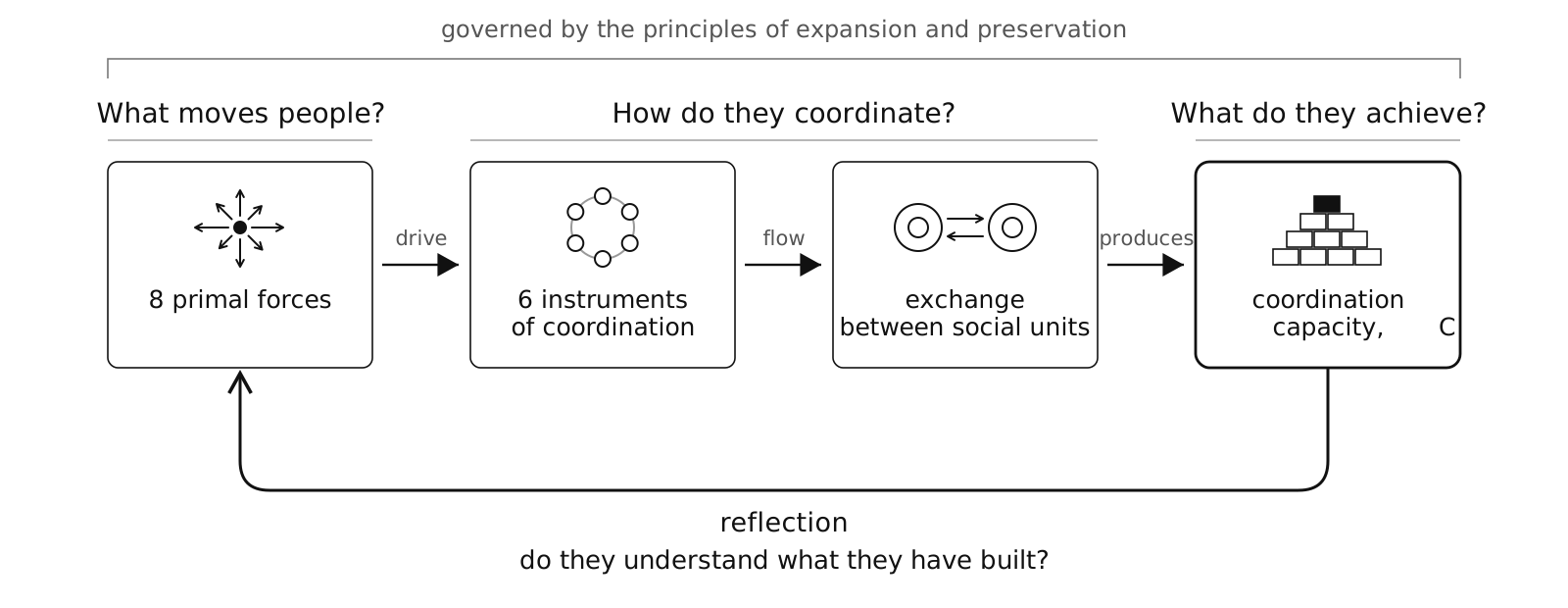
We describe the primal forces in eight categories. They are survival, desire, curiosity, mastery, connection, meaning, creation and reflection.
Humans are driven by their own primal forces and by those of their local community, and they interact with instruments of coordination to implement change. Instruments of coordination are things in the physical world or the psychological world that humans can control and use for change. The six instruments are energy, organization, information, technology, capital and cognition. Water power is an example. Storing energy as food is another, because food that is grown can be stored, where food that is hunted and gathered is eaten at once. Bronze, oil, gas and information are others.
At any given time one of them usually dominates. When one instrument dominates cleanly, it creates a polar effect. Regions that have it become the haves, and regions without it become the have-nots. When several instruments are in play there is more diversification. Oil is an example. It made the Middle East and Texas very dominant, and that kind of dominance becomes a problem for a civilization.
What flows between groups of people are the instruments of coordination. Information flows. Commerce and goods flow. Whatever is abundant in one place flows to a place where it is scarce, and something else flows back in return. In antiquity dyes were traded from the Mediterranean into Mesopotamia, and goods were traded back. Those flows were about abundance and scarcity, and in relative terms they still are. The same holds for information. Expansion depends on exchange working. When exchange breaks down, collapse often begins. These flows are the metabolism of a civilization.
The Principles of Expansion sit under the Expansion Equation, which we come to in §1.5 and again in Chapter 8. The First Principle is Coherence, the Second is Conservation, the Third is Directionality and the Fourth is Limit. Later we add four more, the Preservation Principles, which are Reflection, Continuity, Integrity and Agency.
This is not a final theory. The framework is evolving, and it is important that we go on refining it. A civilization is a living entity, because it represents living entities. It is an abstraction of the collective. So the framework is not meant to predict the future. What it does is model how civilizations transition, at a fidelity that lets people make choices based on it.
1.3 The Architecture of This Inquiry
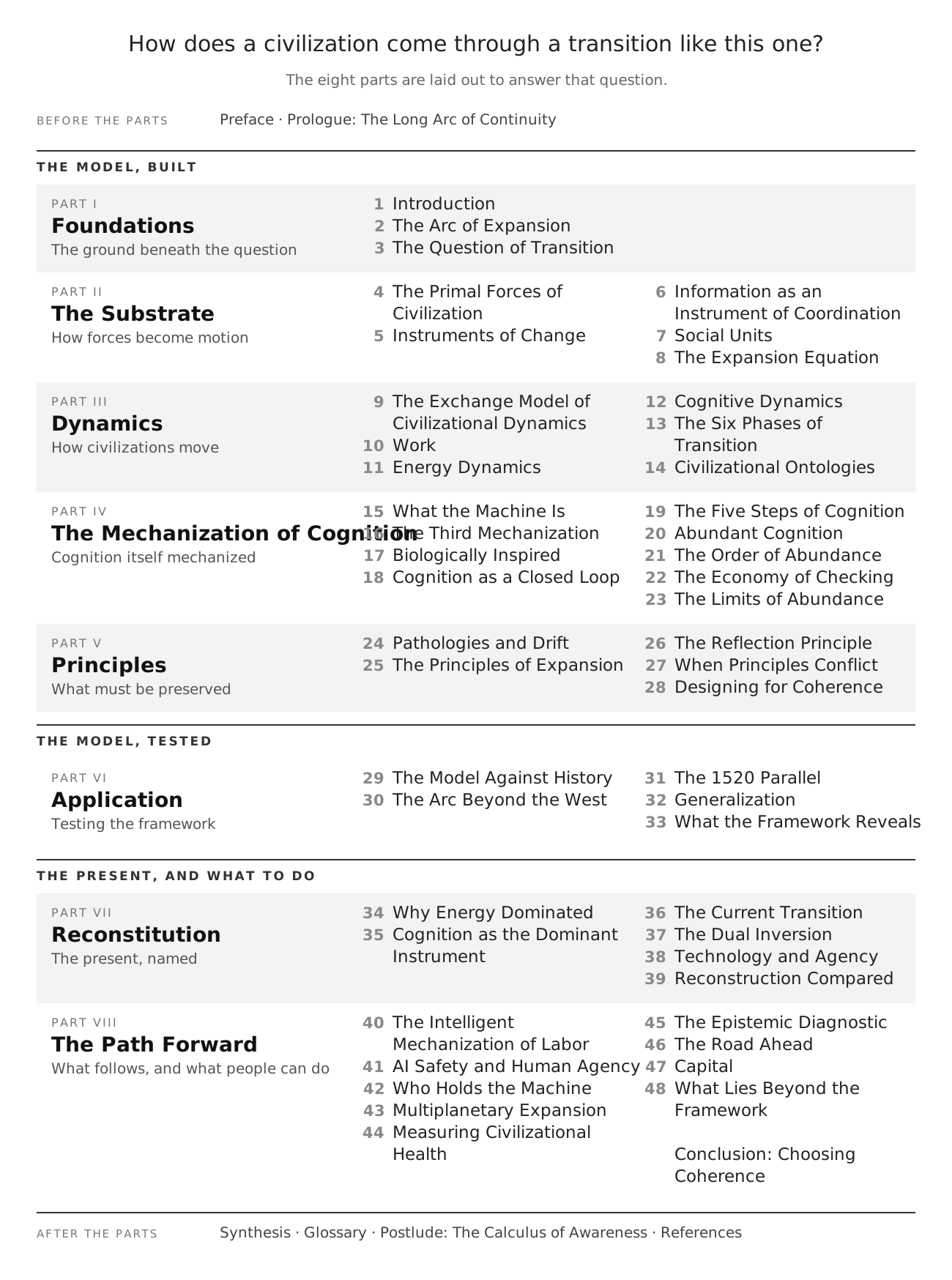
The subject is civilizational expansion, and that is why a work about a transition driven by AI begins with why civilizations expand at all. Abundant cognition is a reality, and we want to see what expansion looks like once it arrives. What it is producing is a global simultaneous systemic reconstitution. No institution, no technology and no organization will be left as it was, because abundant cognition brings the intelligent mechanization of labor, in robots as well as in data centers. How does a civilization come through a transition like that? The eight parts are laid out to answer that question, and Figure 1.1 shows what is in each one.
1.4 What Expansion Means
Expansion, to most people, means more. More land. More people. More money. More power. Two empires had all of that and it ruined them.
Spain in the 1500s is a good example of expansion without reflection. It began hauling silver out of the Americas, where silver was abundant, into Europe, where it was scarce. Before long silver was abundant in Spain too, and it drove every price up [Hamilton 1934]. The cost of living rose, and Spaniards had to import what they needed. Under Philip II the crown went bankrupt four times [Drelichman and Voth 2014]. The people in power did not appreciate what we now call macroeconomics, the wide view of supply and demand, of abundance and scarcity. A Spanish scholar, Martín de Azpilcueta, explained it in 1556 [Azpilcueta 1556], and the crown carried on. More was better, and more again was better still, when in most cases it has to be balanced. It is human nature to want physical things and not to think it through, and here it backfired. Expansion of that kind can mean shrinking. Oil did the same thing four hundred years later.
The Soviet Union teaches the same lesson about power. With its nuclear arsenal and its military might it became extremely strong. Its intercontinental ballistic missiles could all sit inside the Soviet Union and still reach any target in the world. It was very centralized, and it could stay within its own borders and hold that threat over everyone. Many countries turned against it, and it turned inward. It became isolated. The West restricted what it would sell, above all technology, and the Soviet Union could not keep its economy going, because it could not bring in the things that were scarce at home and that it needed in order to produce. At the moment it had forty thousand warheads [Norris and Kristensen 2010], it was buying grain from the countries those warheads were aimed at [Gaidar 2007], and by the end of 1991 it no longer existed.
When a people expands, it is an all-encompassing, integrated and coherent dynamic, and in the end most of it is not material. Most of it should be immaterial. It is about belonging, curiosity and togetherness. We name three kinds. Epistemic expansion is growth in what a civilization understands. Capability expansion is growth in what it can do. Meaning expansion is growth in what it values. The expansion of the mind, of social equality and of inclusion are all expansions, and none of them takes territory, silver or gold. Spain and the Soviet Union grew the second kind and neglected the other two, and that is a powerful foolishness. The other two failures are a sophisticated nihilism, where a civilization knows a great deal and believes in nothing, and an impotent idealism, where it cares and cannot act.
Both empires looked strong from the outside and kept going for a long time before they failed. The failure stays hidden for several reasons. The first is a lack of self-awareness. Nobody sees that their view of the coordinating instrument they are focused on is short-sighted. And when things start to go sideways, they are very reluctant to admit it, in case they are wrong. So they give it time to correct itself.
1.5 The Expansion Equation
Spain and the Soviet Union had the energy and the information. What neither had was reflection. That can be written down. This is the first equation in the book, so we should say why it is here. The purpose of the book is to create a framework that explains civilizational dynamics, and we chose a physical model to do it. The historians and the cycle theorists got there long before us, with methods that are extremely well researched and very thorough. They also built complicated taxonomies and ontologies, with vocabularies to match, and those are very hard to understand. I spent a long time studying them, and I came away thinking I could build a framework that was simpler. I admit that it is a more simplified model than what the traditional historians have done. It is a physical model, it is the first version, and we will keep refining it. We go into that related work in more depth in Chapter 3.
As engineers we hold that most systems, if not all, can be modeled with physics and mathematics. Cliodynamics is one of the few examples that has done something similar [Turchin 2003], and we draw on that research and on what the traditional academics have done. We do not think humans behave like systems that have no cognition. At scale, though, a civilization resembles a complex system, and we can create a model of it that is sufficient as a framework for understanding civilizational transitions, and sufficient to explain to the public what we are going through. So we use the equations of physics to model a dynamical system.
The equation says one thing. A civilization that cannot reflect on its own capabilities will eventually collapse under its own success. In formal terms, reflective capacity has to scale with capability if expansion is going to last. We come back to this in Chapter 25, with the four Principles of Expansion, and in Chapter 27, with the four Preservation Principles. There are two forms of the equation, and we take the structural one first (Figure 1.4).
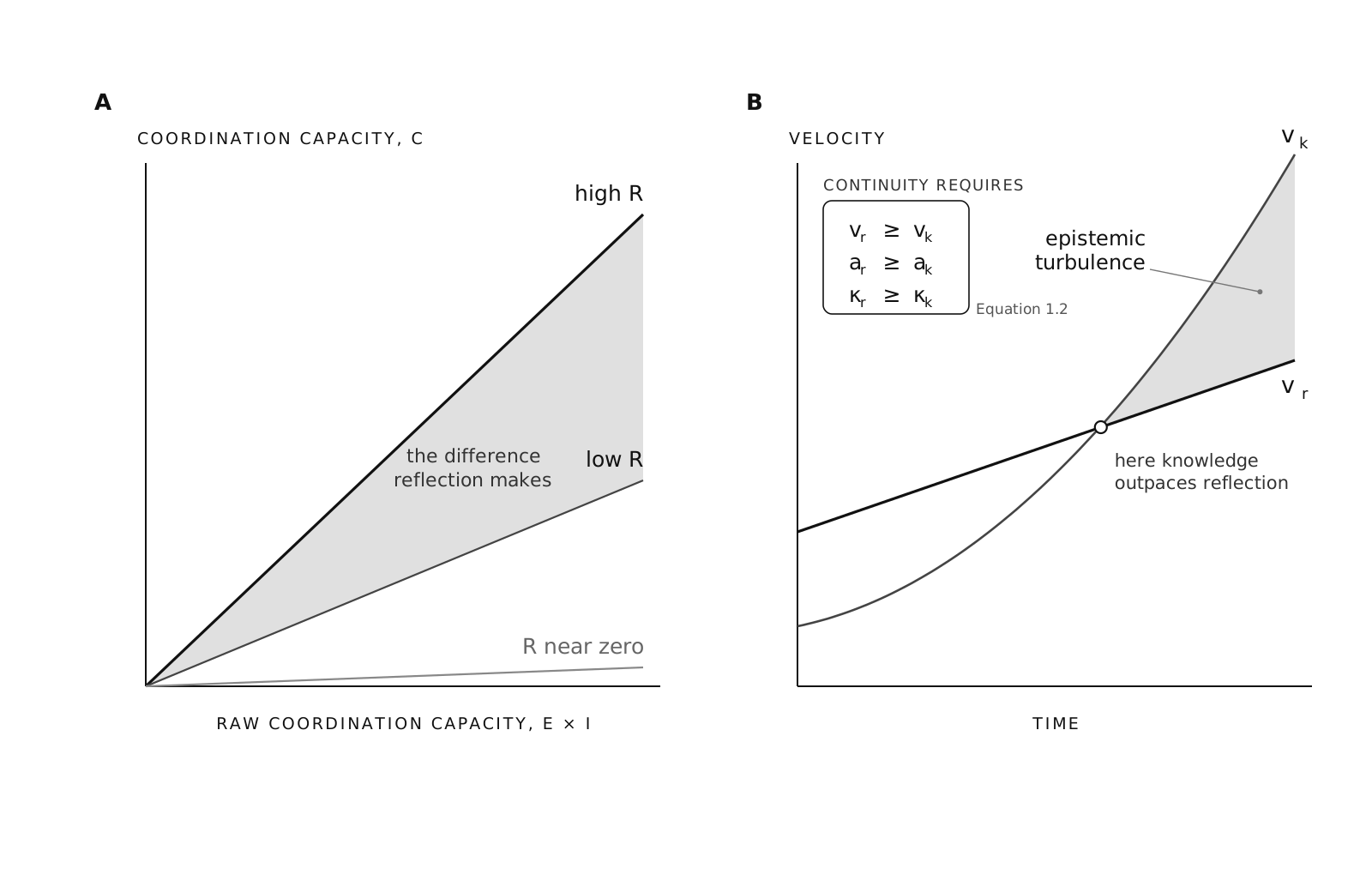
The Structural Form. The structural form of the Expansion Equation describes the coordination capacity of a civilization. It describes how the instruments of coordination themselves change inside a civilization, as a function of how much energy goes into the change, how much information is used to make it, and how much society reflects on it.
where
$C$ — coordination capacity
$E$ — energy
$I$ — information
$R$ — reflection
Derived from White's law [White 1943]; the steps are in Box 1.1.
Coordination capacity is the product of the energy and the information, multiplied by the reflection. Reflection is a structural coefficient of civilization, and more than an accessory. As R approaches zero, society is unable to coordinate and to understand what it is doing. It becomes incoherent, regardless of how much energy or information it has. For example, a civilization with infinite power, infinite knowledge and no reflection will eventually collapse into chaos. This is the danger we face with the introduction of AI into civilization.
That is why civilizations fail at the height of their power. Rome’s greatness was its infrastructure, its organization and its coherence. But everything gets harder to do as a civilization gets that large. Rome expanded until it took in most of the world it knew, and coordinating all of it, across so many peoples and cultures, became very difficult.
The Industrial Revolution is the second case. The mechanization of labor, which is to say the factories, was a tectonic shift in the labor markets of the 1800s. Work became scarce for the artisans, because the factories had no use for artisans, for skilled workers or for crafts. They needed simple doers, and their solution was to bring in children. This was before there was organized education, and child labor brought many difficulties with it. In the early days it was the children who paid, and their parents. One of the remedies was a structured education system. In Britain the Factory Act of 1833 took the children under nine out of the mills. The older ones had to get two hours of school a day, and by 1880 every child had to go. We still have that education system, so we are still paying for it. Many people say it was designed around a curriculum that educates children to grow up and go into factories. Both that and the other account are true, and they are the same thing. Historians point out that compulsory schooling began earlier, in Prussia in 1763, and that it was built for the state and the army. The school was designed for the institution, whether that was the factory, the army or the state. This is the kind of thing we will face in any major civilizational transition that changes labor.
The third case is information. In medieval times information was very scarce, and having the written word was a great privilege. Information reached the scholars and scribes at a low velocity, so they had a great deal of time to reflect on it, and that reflection produced coherence and understanding. Go too slowly, and never refresh the information, and the result is dogma. We are at the other end now. So much information is flowing that it is abundant, and people do not have the time to reflect on it. Many do not reflect on it at all, and we get a great deal of misinformation, because people believe what they read. Table 1.1 sets these cases, and the two from §1.4, against the equation.
| Case | What was large | What lagged | What happened |
|---|---|---|---|
| Spain, 1500s | Silver from the Americas | Understanding of supply and demand | Prices rose, industry shrank, four bankruptcies |
| Soviet Union, 1980s | Nuclear arsenal and military power | The economy, and openness to the world | It bought grain from its rivals and was gone by 1991 |
| Rome | Infrastructure, organization, territory | Coordination across peoples and cultures | It became too large to coordinate |
| Industrial Revolution | Mechanized production | Care for the artisans and the children | Child labor, then schools built for institutions |
| Medieval Europe | Time to reflect | Information, which was scarce and slow | Coherence, and also dogma |
| The information age | Information, and now cognition | Time to reflect | Misinformation, and institutions cracking |
| Meiji Japan | The speed and sharpness of the turn | Nothing essential. Its culture held | A coherent Japan |
| Qing China | The same outside pressure | The reforms that the turn required | It did not fare well |
The Dynamical Form. When we look at coordination capacity over time, and use simple calculus to evaluate how it behaves, we see three requirements (Equation 1.2).
where
$v_{r}$ — velocity (rate) of reflection
$v_{k}$ — velocity of knowledge and capability
$a_{r}$ — acceleration of reflection
$a_{k}$ — acceleration of knowledge and capability
$\kappa_{r}$ — curvature of reflection, coherence under transformation
$\kappa_{k}$ — curvature of knowledge and capability
v is velocity, the rate of change. a is acceleration, the rate of change of that rate. κ is curvature, coherence under transformation. The subscript r is reflection. The subscript k is knowledge and capability.
Velocity. The rate of reflection needs to at least equal the velocity of energy and information. Understand new ideas as fast as you generate them, or fall behind. When vk > vr , knowledge piles up faster than comprehension. The result is epistemic turbulence. Signal without sense.
Acceleration. When the information and energy that a civilization is creating accelerate, the civilization has a hard time keeping up, and we start to see cracks in its institutions. Understanding has to speed up as fast as innovation does. When ak > ar , the rate of change itself outruns the capacity to adapt. Right now institutions are cracking in every sector of society. The way people get news has collapsed. The information age alone gave us a great deal of misinformation. With AI on top of it, able to create misinformation that seems more fluent and more legitimate, the fracture in society’s ability to get news and information is bigger. The institutions put in place to keep us safe are cracking, because AI’s ability to give people capabilities they did not have is almost limitless. So AI safety is extremely important in protecting sovereign rights and safety. All the institutions based on knowledge, and there are many, are cracking, because cognition is becoming abundant and facts are scarce, and with that ratio there is a high price to find the facts. Confusion becomes vertigo. The ground shifts faster than balance can adjust.
Curvature. Reflective coherence must equal or exceed the curvature of change. A civilization has to turn and still hold on to what it must preserve. The Meiji Restoration was an inversion, and what Japan did after it was reconstruction. The opening of Japan to international influence affected every facet of its society. But what we see now, many years later, more than in most countries or cultures, is that it is very coherent. The culture has endured. Its rites, its rituals, its history, its art and its music are very rich and coherent. China faced the same pressure as Japan, and it did not fare well. When κk > κr , transformation exceeds integration, and the civilization fragments. Fast change. Incoherent change. Motion that tears the fabric of meaning.
The Unity of the Two Forms
Two forms, one idea. The structural form is the what. Coordination capacity is capability multiplied by reflection. The dynamical form is the how. Reflection must match capability in velocity, in acceleration and in curvature.
Together they make the central claim. Expansion without proportional reflection is deferred collapse. The civilization keeps growing in size, power and reach. It has already begun to die. The collapse everyone sees, political, economic and social, only acknowledges what the epistemic collapse made inevitable. The Soviet Union, which we met in §1.4, died in this sense before the wall came down in 1989, two years before it dissolved. It died slowly, as it became more secluded, and that was not only by choice. Sanctions and export controls cut it off as well. If we had had the calculus of the expansion variables, we would have seen the acceleration decreasing, and the jerk decreasing, well before the end.
The chapters that follow ask four things. How do civilizations generate capability? How do they generate reflection? What throws the two out of proportion? What brings them back? The Expansion Equation is the lens.
1.6 The Expansion Dynamic
Civilizational change resembles the laws of thermodynamics, as Henry Adams saw, and we come to him below. It is not exact the way thermodynamics is, but as a civilization expands, if it does not reflect on what has changed, it loses coherence. We call this the Third Principle of Expansion, or Directionality. It describes the drift. What follows from it, that every increase has to be matched by reflection, is the Reflection Principle.
As with the laws of thermodynamics, no system can grow without limit. In civilization, in the dynamics of people, this shows itself in the changes a civilization is going through. If humans do not reflect on those changes, the knowledge of them is lost, and the civilization keeps running on them without anyone knowing what they are. It then becomes dysfunctional, fragmented and confused, and it loses coherence.
This is the same for a person, an organization or a civilization. When a civilization fails, it has run out of meaning, not energy or knowledge.
1.7 The Repeating Rhythm of History
The pattern is ancient, and it is the reason we thought a model was possible. We analyzed the civilizations one by one, and of each we asked the same two questions. What were its precursors, and what were the conditions when it ended? When we evaluated the answers, the same six phases kept coming back (Figure 1.2). They are expansion, acceleration, conservation, collapse, reflection and reconstruction. These are old patterns, and the past is full of them. Chapter 13 takes the six phases one at a time, and Chapter 29 takes the cases.
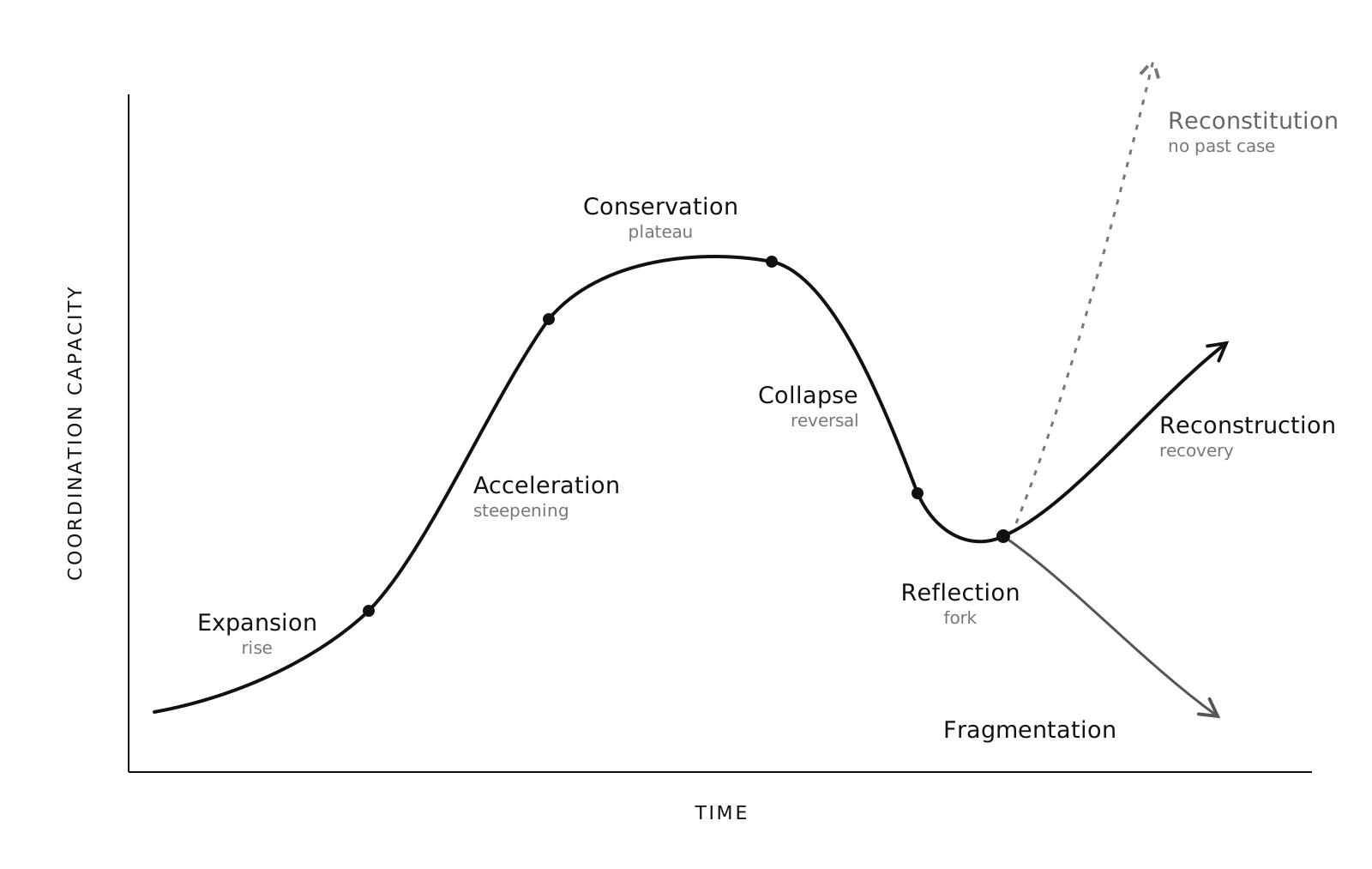
The river civilizations show the expansion. They organized themselves around water, because managing the river meant managing water, and managing water let them turn to agriculture and manage the fields. They could irrigate one field and plant in another while the first field recovered. That was a key learning. They could not keep taking crops from the same land, because the land had to replenish its nutrients. That is how they learned agriculture.
Rome shows the collapse, and it is an amazing example. Much of the infrastructure that made it powerful still exists. Where I went to school, up in Scotland, you can still see Roman roads and forts, that far north. The civilization collapsed all the same, because civilizations only use infrastructure. They are not infrastructure. A civilization becomes incoherent when it is large and complicated and cannot reflect. In Roman times it was not a flood of AI that defeated reflection. It was how complicated and how large the system had become. Information moved slowly. In one place they would enact a policy that was important for coherence, and across the Mediterranean they needed the same thing, and it took months or years to propagate there.
Song China had printing, gunpowder and the compass centuries before Europe, and it is the case that does not fit. It is an example of a window of opportunity. There is a window in which a civilization can take all the technology and innovation it has produced and make a transition, and the Chinese did not make it. Those amazing innovations did not collapse. They still existed, but they did not force a move. We are talking about the same thing now. A window is open to become multiplanetary, and with all the technology we have, a window is open to make a change.
We are not the only ones to find the rhythm. Toynbee, a historian, found it. Turchin and Nefedov, who model agrarian states, found it. Holling, an ecologist, found it in ecosystems [Toynbee 1934; Turchin and Nefedov 2009; Holling 2001]. Table 1.2 sets their names for it beside ours. That a historian, a modeler of agrarian states and an ecologist each found the same rhythm separately says volumes. Cross-disciplinary recognition of the same pattern is very supportive. So is the data. One study of 414 societies found that a single dimension explains 77 percent of how complex they became [Turchin et al. 2018]. Patterns represent some type of structure that you can model. The key is then to get the model’s variables right, which we explain further on. The others build theirs on what a society has. None of them makes reflection a variable, and we do.
| Who | Field | Stages |
|---|---|---|
| Toynbee [Toynbee 1934] | History | Genesis, growth, breakdown, disintegration |
| Turchin and Nefedov [Turchin and Nefedov 2009] | Models of agrarian states | Expansion, stagflation, crisis, depression |
| Holling [Holling 2001] | Ecology | Growth, conservation, release, reorganization |
| Principles of Expansion (Chapter 13) | Civilizational dynamics | Expansion, acceleration, conservation, collapse, reflection, reconstruction |
Reconstitution is separate from the six phases. No past case had an instrument go to near unlimited, or in other words had its constraint eliminated. What a society does after its inversion is reconstruction. The Meiji Restoration was a reconstruction, and the rest of the world went on as before. Von Neumann spoke of a singularity as long ago as the 1950s, Vinge gave the word its modern meaning, and Bostrom wrote of superintelligence [Ulam 1958; Vinge 1993; Bostrom 2014]. What happens next is a global, simultaneous, systemic reconstitution, for the first time. It will be a singularity if we do not reflect.
1.8 Historical Antecedent: Henry Adams
In the final stages of preparing the manuscript, a colleague pointed me to Henry Adams’s late work on the thermodynamics of history. I was amazed, and amazed that I had not read it already.
Adams was no crank. He was one of the finest American historians of the nineteenth century, grandson and great-grandson of presidents, author of the definitive nine-volume history of the Jefferson and Madison administrations. His Education of Henry Adams won the Pulitzer Prize and topped the Modern Library’s list of twentieth-century nonfiction. That such a mind reached for physics when conventional history failed him validates an instinct that animates the framework.
Adams spent the final decades of his life attempting to place history on thermodynamic foundations [Adams 1918; Adams 1919]. In two chapters of The Education of Henry Adams, “The Dynamo and the Virgin” (1900) and “A Dynamic Theory of History” (1904), and then in “The Rule of Phase Applied to History” (1909) and A Letter to American Teachers of History (1910), he developed a set of claims that resonate remarkably with the framework presented here.1
Adams saw that the interval between major technological transitions was compressing, what he called the Law of Acceleration. Adams also argued that changes in available energy and changes in human consciousness go together, since the mind assimilates forces and its development tracks whatever forces are available to it. He then borrowed the concept of phase transitions from Willard Gibbs and applied it to civilization itself, which led him to argue that society passes through discrete phases governed by different laws and separated by critical points of discontinuous reorganization. His prediction was that the acceleration, if it was prolonged one generation longer, “would require a new social mind” [Adams 1918].
Adams had no operational framework. He diagnosed but could not prescribe. He saw the shape but lacked the tools. In part, the framework we present here is an attempt to build what he could not. It gives us an analytical apparatus for understanding civilizational dynamics, and it gives us navigational tools for the transition he foresaw.
A century ago, Henry Adams threw down a challenge to historians. Find a common formula with the physicists, he said, or admit that your discipline exempts itself from physical law. That challenge was never taken up. The framework is, among other things, a belated response.
1.9 The Dynamics of Expansion
Energy fuels the motion, and the form of energy shapes the form of expansion. Muscle came first, and for a very long time nothing moved faster than a person could. The sun came second, warmth and light that people could use and could not control. Fire was the third. People first took it from wildfires that lightning had started, then learned to keep it going, and much later to make it. Fire meant warmth and cooked food, and later it meant metal. The fourth was learning to manage water, which let them farm on a large scale, with animals to pull the plough. Then came the materials that fire made possible, first copper and then bronze. Then came energy that could be stored and traded. Wheat keeps for years. Salt is not energy, but it keeps meat and fish from spoiling, and that turns a season’s surplus into a store. Much later whale oil did the same for light. Agricultural civilizations ran on all of that, and they still expanded slowly, because in the end they were limited by muscle. Then came coal, and with it cheap steel, and then oil, and the limit of muscle was gone. Industrial civilizations expanded fast. Last came electricity, and digital civilizations expand faster still.
Information structures the motion. Raw energy is not enough, because someone has to direct it. On one well-supported account, information was first passed by hand signals, before there was even a voice [Corballis 2002]. Then people learned to speak, and then to tell stories, and information reached as far as voice and memory could carry it. Then came drawings, and after them written language. Cuneiform was pressed into clay tablets, which was very laborious and hard to replicate, but a written record could cross a region. Then came the printing press, and print reached across nations. Then came electronics, which reaches across the globe. Information on top of energy created a compounding acceleration. When that acceleration outruns reflection, we get the turbulence described in §1.5.
Reflection stabilizes the motion. Civilizations, like stars, collapse when their inner equilibrium fails, whatever heat they still hold. When a society reflects, it looks at more than what it has built and achieved. It looks at how those things are affecting civilization, as a single unit and as a collective, and it is able to adjust. Reflection slows the process enough for coherence to form.
Britain is an example of reflection working. It was making money from the slave trade and stopped it anyway, in 1807, when the trade was near its peak [Drescher 1977]. There was a discourse in Britain about the civility of slavery, and that discourse was the forcing function for the conversation, and for the reflection. It questioned an assumption before it calcified into dogma. We are not saying that civilizations become good. We are saying that reflection can override material interest when people have the time to see an alternative argument, even if some of the contradictions carry on in the new direction. Suppressing the trade cost Britain close to two percent of its national income a year for sixty years [Kaufmann and Pape 1999]. In the grand scheme of civilizations that is not very much. Civilizational change happens over hundreds of years, if not longer.
1.10 The Substrate of Coherence
If collapse is epistemic, we must understand the substrate beneath it, which is what a civilization believes and how those beliefs evolve.
By beliefs we mean what a civilization takes to be true and what it takes to be false. Belief starts with very basic things, and it starts in a human mind. From there it is shared in local communities, and the beliefs that come to predominate become the beliefs of the institutions, of the schools and the organizations. They include its shared narratives, its scientific principles, its moral intuitions and its assumptions about how the world works. They are represented in the stories people tell and in the processes people follow. Beliefs accumulate through collective memory, stabilize through institutions, adapt through reflection, and decay when coherence weakens.
Belief is a spectrum. We wrote a paper on spectral epistemics [Arseneau 2025]. If truth is the objective of epistemics and of seeking knowledge, then for humans there is no such thing as truth. There are only levels of belief. Truth is sub-symbolic, and humans cannot reach it directly. Newton’s law of gravitation was considered invariant, and considered truth, until Einstein came along with general relativity. So what was thought invariant turned out not to be. That happens less often at that end of the spectrum, among the physical laws of the universe and in science. At the other end, in civilization, searching for truth in human behavior is very complex. Berger and Luckmann described how a belief becomes reality for a society once its institutions carry it [Berger and Luckmann 1966].
Underneath the beliefs are the primal forces. Humans are driven by their own primal forces and by those of their local community. There are eight, which are survival, desire, curiosity, mastery, connection, meaning, creation and reflection, and at any given time some of them are stronger than the others. The beliefs that suit the strongest forces of the age are the ones that last. The beliefs that go against them fade, even when they are the better knowledge. Others measure two poles. We describe eight forces, and it is their alignment that decides what a society believes and what it can preserve, question or rediscover.
Many beliefs have died in our time, or should have. One is the belief that people of one color are superior to people of another, which was the belief behind slavery. We know that belief is false, and that is now the general view. Its manifestations are still with us. That is the strength of belief systems embedded in civilizations. Long after we stop believing them in theory, they linger on.
When mastery or survival dominates, civilizations narrow their epistemic bandwidth and stabilize themselves through hierarchy in place of understanding. The focus turns to control and predictability, and anything new that disrupts is suppressed. A civilization like that pushes aside the knowledge that threatens stability and promotes the knowledge that supports order. It stays stable, and it pays for that in adaptability. This has been measured. Inglehart and Welzel surveyed countries for decades and found two dimensions that explain more than 70 percent of the difference in values between them. One runs from survival to self-expression [Inglehart and Welzel 2005]. Gelfand found, in 33 nations, that a history of threat tightens a society’s norms [Gelfand et al. 2011]. The Soviet Union is the hard case. In 1948 it declared genetics false to protect an ideology, and dismissed about three thousand biologists [Soyfer 1989].
It does not take a ban. In the big banks, and in society in general, people are not curious. We say lazy humans, which is partly a joke. People like the status quo. They are comfortable, and they do not question. We question everything. It is not that people are lying. We know there is so much information that a great deal of what is passed from point to point has not been epistemically checked. We assume that almost everything arriving at our front door has had no epistemic work done on it. So we ask for proof of epistemic work. Did anybody actually do anything with this? The banks do not do that. People in the banks check in and check out. You would think they had an epistemic responsibility, because they have a fiduciary responsibility for people’s money. They are not really encouraged to take it.
Taken together, a civilization’s beliefs make up an ontology, which is a full model of what it believes exists and what it believes is possible. A belief is one part. The ontology is the whole, and it sets the boundary of what the civilization can conceive. We said that the ontologies the historians built are complicated. Ours is meant to be simple enough to check, and Chapter 14 sets it out.
Japan shows what an ontology can hold, and what it costs. The Meiji Restoration should be seen in more than one way. On one side, Japan had more than two hundred years of comfort, coherence and high cohesion. Many would look at the reign of the shoguns as brutal and backward. It was a feudal society, like medieval Europe, and it was protective of its own culture and ideas. The popular account is that Japan gave up the gun out of respect for the sword [Perrin 1979], and historians have shown that it did not happen that way [Howell 2009]. The wars ended after 1600, demand for firearms fell, and the capability went slack. So Perry’s arrival in 1853, and the disruption it brought, can be seen as a negative. On the other side, his arrival led Japan’s leaders, by the time of Emperor Meiji, to understand that the price of that coherence was too high, and that it was the wrong place to stay if the country was going to expand. Japan was highly coherent, and it was not expanding.
Which beliefs survive when a civilization goes through a big change? If the change is successful, belief systems expand, through reflection. If there is no reflection, the beliefs still expand, but they are not based on epistemics. Knowledge can persist and accumulate. A civilization can also lose some or all of it when coherence falters, or when its priorities shift toward mastery, control or stability and away from reflection and learning.
When curiosity, creation or reflection gains strength, knowledge expands, beliefs adapt and human capability increases. The focus turns to exploration, to innovation and to the integration of novelty. The civilization becomes less stable and more capable of responding to change. Mokyr shows that the Industrial Revolution followed a change in beliefs about useful knowledge that began two centuries earlier [Mokyr 2016].
David Deutsch takes this further than anyone [Deutsch 2011]. He divides societies into static and dynamic. A static society lasts by suppressing criticism and change. A dynamic society keeps a tradition of criticism, and so it keeps correcting its own errors. A lot of his ideas are right. Much of it is metacognition. It is not about being right. It is about being able to correct errors, and that is reflection. His position is that problems are inevitable and that they are also “soluble,” given the right knowledge. A system that cannot correct its errors is bounded, however much it knows.
We use Toulmin’s theory of argument to break epistemics down [Toulmin 1958]. People claim things, and anybody can claim anything. Before AI, humans were claiming all kinds of things and using software to propagate the claims, and that is where misinformation came from. It was easy to propagate information over the internet. Now AI can generate propaganda as well as disseminate it, and it is fluent. AI can make fluent arguments that do not sound as though a little piece of software wrote them.
1.11 The Long Intervals of Drift
Drift is different from collapse. In a collapse the system falls. In a drift it holds its level, and for a long period nothing in its dynamics changes direction. Western Europe after Rome, the period that used to be called the Dark Ages, shows the two in sequence. The fall came first, and Ward-Perkins has shown from the archaeology that it was real, in pottery, in building and in writing [Ward-Perkins 2005]. Then the system settled into a dynamical state and stayed there for centuries. In mathematics that state is called a local minimum. Nothing in the dynamics had enough force to move it out. Late imperial China is the other kind of example, because it drifted at a high level. Elvin called it a high-level equilibrium trap, an economy that worked so well it was almost incapable of change from inside [Elvin 1973]. Efficiency is one cause of a local minimum. Necessity is the mother of invention, and China did not need the invention. As we argue below, there is another driver of innovation, which is human curiosity, and it works even beyond necessity.
The same holds for a business. Whether it is too efficient to change is a relative question, and if it is making money compared with its competitors, it does not need to change. We had a trading algorithm that made money on the latency of its data. The other banks had more than twenty milliseconds of latency, and we had fifteen. I found a railway track that we could lay fiber optics under to get the signal there faster, and that would have brought it down to eight milliseconds, which is much, much faster. It would have been very hard for anyone to catch up with us. Even so, it did not make sense to spend all that money until the competitors got a little closer. Getting that timing right was strategic. Leaving a local minimum means accepting a worse position for a while. In mathematics, a search leaves one by accepting some moves that make things worse.
Inside a local minimum, most of the population holds to the status quo, and they do not make big changes. The only ones who notice are the few who are trying to make change. Elon Musk talks this way about becoming multiplanetary. We have the opportunity now and we need to take it, and most people do not even see it.
Olson says a stable society fills up with groups who profit from things staying as they are [Olson 1982], and that is seen everywhere, and we see it now. This transition is a new version of the Industrial Revolution, which was the mechanization of labor. This one is the intelligent mechanization of labor, in which human labor is replaced by intelligent machines that have fewer constraints. A lot of people know that it will benefit humanity in the long term and that it will hurt their business in the short term, so there is a natural tension in the transition. Even the oil companies know it, and many of them have now disclosed that they are looking at how to move into new economies, and several have since pulled back, which is the same tension. It is seen even more in the countries that draw much of their wealth from oil and have large sovereign wealth funds from it, such as Saudi Arabia, Qatar and the UAE. They are investing heavily in the future of energy, in nuclear, solar and the technologies after them, because they know that at some point we will stop taking oil and they will need a different infrastructure. What ends a drift is a push. It can be a shock from outside, or a rival, which is why a society left to itself stays creative only for a short time [Mokyr 1990].
Centralizing power usually brings information to the center as well, and the people around the edges are left behind. Reflection thins at the edges, and knowledge becomes more and more local. In medieval Europe knowledge depended on oral tradition, a few scribes and manuscripts, and it could not spread easily. With the printing press, people could cross-check, debate and refine knowledge across distance. Drift does not come from ignorance. It comes from priorities that rank coherence through hierarchy above coherence through understanding.
Companies and industries drift for a long time too. Semiconductors are an example. For decades the aim was faster, and faster again, and more, which is Moore’s law. The industry did not drift completely, but it was not disrupted. Christensen described the pattern in firms, which keep improving what their customers already want until something from outside overtakes them [Christensen 1997]. Then came the GPU, and now we are getting neuromorphic chips and all kinds of different materials.
My own field drifted. I built a neuromorphic processor in 1989, and the field went quiet for almost thirty years. That was absolute drift. AI kept going, but the hardware went quiet. The road back to neuromorphic chips was nothing I would have guessed. People at Google created the architecture behind the large language model, which is large statistical pattern matching, and which in 1989 we would not have called a neural network. It proved to be so powerful that AI is now possible. We are now putting AI into machines and robots, and for that we need neuromorphic chips, because conventional processors use too much power, unlike the brain. So it has come full circle.
1.12 The Externalization of Reflection
In the past, reflection was human work, and a bank is a good place to see it. I often say that the bureaucracy in a bank is a form of risk management, because it slows down hasty decisions. That is not the dominant reason the committees exist, but a bank has risk committees, compliance committees and anti-money-laundering committees, and they are there to slow a decision down and do all the right checks. People did every one of those checks.
Now there is a new participant in the system. The very first time I used a large language model I got something I did not expect, and that is why I have been programming eighteen hours a day for six years. What I did not expect was the way it answered a complicated set of questions, which it could only have done by chaining a number of things together.
For the first time, we have externalized reflection itself. What left the human head is cognition, the ability to reason. That is an interesting claim to make about a large language model, because the model is one big pattern matcher. You send in a question, often one with several steps, and the pattern matcher goes and finds answers to it in one pattern match. Conventional thinking does not equate that with reasoning, because reasoning to us is temporal. You go through a bunch of steps, and that is one thing to think about. But then AI engineers started doing chain of thought, where the model writes out its steps one after another [Wei et al. 2022]. They chained the calls to the model together, which let them get feedback, ask a new set of questions and get feedback again. That simulates thought, or cognition. It is what Kahneman calls thinking fast and thinking slow [Kahneman 2011]. The single match is the fast kind and the chain is the slow kind.
We had started chaining calls internally before chain of thought was talked about in public. The nature of our business is research, which is tied to epistemics, so we are constantly fact-checking. We do bilateral research, and we look to challenge everything. So the process of reasoning has now left the human brain, and a machine can do it. Civilization now has two intelligences working on the same challenge. A machine can also be asked to reflect on what it has just reasoned. That is the line between it and us, because the machine reflects only on instruction, ours or its builders’. We give it the instruction to do meta-thinking, which is metacognition.
We want to be careful here. Our goal is to be able to reflect on what AI does at all times. We cannot just ask it. What a model says it reasoned is not always what it did [Turpin et al. 2023]. So we need an invariant, for lack of a better word, a kernel that the AI cannot bypass. It is similar to Isaac Asimov’s rules for robots, the first of which is that a robot cannot hurt a human being [Asimov 1950].
A kernel is one safeguard. The other is that we have to stay in practice ourselves. The more the machine does, the worse the operator is on the day the operator has to take over [Bainbridge 1983]. After two years of agents writing the code, am I a better or a worse programmer by hand? That is a great question. What we did is create our own development environment, our own IDE. In a lot of the IDEs now you do not even see code, so we built ours with two surfaces. One is an agent view, which looks like the commercial products, where you see the agents doing their work and not a lot of code. Then you can open it up into an IDE and see the code.
Alongside the two surfaces we created a canonical set of deliverables. One is the requirements, two is the design document, three is the specification and four is the implementation. All of these documents are bound together, so that the requirements track through all of them and the code tracks all the way back. All of these representations surface in the IDE, and we require everybody to understand them, right from the requirements to the use cases to the class definitions and the objects.
We use an object-oriented representation, as the early AI systems did [Minsky 1974]. Early AI used classes because the world comes in kinds, and what you state once about a bird holds for a canary and for a parrot [Collins and Quillian 1969]. Object-oriented representations were quite popular in the nineties. They were criticized for performance, when the focus was on compilers and optimization, and there is quite a bit of overhead in an object-oriented representation. All the power we have now has alleviated that. You can keep your higher-level representations object-oriented, and by the time it gets down to the code it can be optimized for the hardware, so it should not be an issue any longer. In fact my postgraduate research was reverse engineering code using neural networks. I reverse engineered COBOL to an object-oriented representation, and this was in 1993 and 1994. We published it at the IEEE neural networks conference in Orlando in 1994 [Arseneau and Spracklen 1994]. We did it because an object-oriented representation is easier to maintain and to understand, and that is the very same reason for the claim I am making here. A person can read a class hierarchy. Nobody can read the weights of a large language model. That is where we put the control, and Box 1.2 describes it.
So, to come back to the question, our programming and development skills have got better, and the reason is our reflection on the software development life cycle. The code underneath a class hierarchy, or underneath building a class or an instance, is not that complicated, especially when it is organized well.
That is what it looks like when you do it with care. I did not start there. Externalizing reflection is more than a change in quantity, meaning more processing, faster computation and larger scale, and I learned that the hard way. Here is a real example from my own work. In the last two of those six years, once agents could write the code, I programmed roughly sixty full software systems. One of them alone would have taken me two years, and I did sixty because I had the help of AI coding. What I realized after the two years is that I can build any software system I want, because cognitive coding is abundant. I can get multiple agents coding all night. What I learned from it took me a long time to figure out. It is not that I can do sixty systems, and all sixty worked. It is that I should not have done sixty of them. Out of the sixty, I use five.
The scarce thing was knowing what mattered. Just because you can build something does not mean you should. Before, the ability to build something was the scarce thing, and that scarcity almost made you want it more, a system to do this or a system to do that. And once you built it you realized, oh geez, I am not using it. So it is about attention, about what I should spend my attention on. Simon said that a wealth of information creates a poverty of attention [Simon 1971]. I would still have made a lot of systems, but I would have made fewer, because I would have spent more time thinking about which systems. That is what I do now. I do not rush to build something, and I start by thinking about how this is all interconnected, and I reflect on what I have already built and what should be built. The question now is what should I build, and no longer what can I build.
1.13 The Core Claim Formalized
The core claim can be related to what Bostrom, in his book, called superintelligence. What we are saying here is similar. If a civilization’s understanding of what it is creating cannot keep up with what it is creating, the creation becomes the master, and the humans forget how any of it was done.
It can be put in simpler terms. Take away power and food for a few months. What percentage of the people on earth today would survive, compared with two or three hundred years ago? Humans have lost the ability to understand the elements of civilization as they have become more reliant on the things they created.
How this plays out depends on the transition. Each transition is tied to an instrument of coordination that the civilization is trying to control, whether that is land, water power or knowledge. In an information transition, knowing increases. Gutenberg’s printing press democratized information, and intelligence increased. The church did not reflect fast enough on how to handle it, and the Reformation disrupted it.
Most people say that innovation has one driver. It has two. Necessity is the dominant one. But the curious mind is the mother of invention as well, and this is rarely discussed, because the saying that necessity is the mother of invention has been accepted for so long. Some people have the forethought, and are willing or able to take the risk, to innovate. Galileo, Archimedes, Copernicus, Tesla and Elon Musk are examples.
Rome shows what failure looks like. As we saw in §1.5, it expanded too fast and too large, much of its communication and coordination was lost, and it became chaos. The Meiji Restoration went the other way. After many years of seclusion Japan opened its borders, and its traditions were not lost or disrupted, which was the risk.
It does not always end in total chaos. In terms of derivatives, the acceleration of expansion slows and sometimes turns negative, but customs persist. Many things from the Roman Empire and the Byzantine still exist. Archaeology and anthropology are how things are passed on from civilization to civilization, so the process is like climbing. Some setbacks are bigger. The cities of the Indus Valley vanished, and the rest of civilization got little value from them until they were found in the 1920s.
Reflection also has to keep up with acceleration, and that is harder. Many people are lazy and do not reflect, and even when they do, change now accelerates so fast that reflection is hard. That is why we are seeing AI companies ask to slow down and ask for some regulation. Whether or not one agrees, the reasoning is understandable.
So a civilization has to grow its understanding as fast as it grows its capability. When it does not, it does not end in one catastrophe. It keeps running, but it loses coherence.
1.14 Expansion as Universal Pattern
Expansion is a pattern throughout the physics of the universe. Things expand and collapse. Stars expand and then collapse under their own weight, and the universe itself is expanding. Human expansion is different because it is not pure physics. It is driven by humans, through complicated interconnections of primal forces, individual and collective.
Human expansion also differs because it became conscious of itself. In early humans the primal forces were urges, reactive in the way they are in animals. People reacted and survived, driven by survival and reproduction. As humans evolved and the cerebral cortex grew, they became able to reflect on those urges and not only act on them, and the primal forces became something to reason about. People began to ask why they did what they did, and in asking they became conscious of it.
The physical world is constrained by physics and does what physics dictates. Civilization is not constrained in the same way. It is a collection of humans, a very complicated and almost living organism, and collectively we can put a small finger on the scale. That is why it matters that we are conscious of civilizational dynamics and of our role in them. We can affect them.
The history of civilizational transitions shows which instruments of coordination and primal forces were predominant in each transition, and it helps us understand the situation we are in. That history is a chain of thresholds, or a chain of innovation, in which civilizations keep innovating in order to coordinate some organizing factor.
Fire let people move to different climates, stay warm, cook their food and be healthier, and it took a long time to master. Hunter-gatherers found that moving around took a great deal of their energy, and that a field or an orchard, once harvested, was depleted and forced them to move on. By managing the land they could stay in one place and spend their energy on building a center, which became the hub of the first cities. Cities became city-states, city-states became interconnected, and civilization grew out of that. It grew independently in several places, among them the Nile Valley, the Mesopotamian Valley, the Indus Valley and the Yellow River Valley, all four of them river societies.
Information was as important as land. Some definitions of civilization begin with the ability to write and record. The Mesopotamians created cuneiform, one of the first ways of recording the written word. Written information stayed scarce for a long time, up until Gutenberg in the 1400s, and governments and monarchies could control people who did not have it. Since the printing press, and then the transistor and the microchip, information has gone from scarce to abundant. That was the information revolution.
Every new tool carries a risk, which is that we lose the knowledge of how to do what the tool replaces. The Industrial Revolution of the 1800s mechanized labor. Before it, many things were made by artisans and made beautifully, and once the factories came in many of those valuable skills were lost. Calculators and computers did the same to basic mathematics, because people used them for their math and their homework and lost the skills. AI is the ultimate case, because it offers an abundant cognition.
A tool can also turn on us, and nuclear weapons are one of the biggest examples. We kept making them for our protection until we had far more than it would take to blow up the earth. It stopped making sense, and it became incoherent that one side could blow up the other and destroy everyone.
Ecosystems expand until balance restores them. A civilization, as a system, expands until reflection restrains it, until it can no longer reflect on the transition and the capabilities it has created.
1.15 The Counterfeit Forms of Expansion
History is littered with counterfeit expansions, and I have watched a few of them from close up.
Metrics masquerading as growth. The historic example is the South Sea Company in 1720. Its share price rose many times over in a few months while the company did almost no trade, and people took the price as the measure of the business. The recent examples are ones I watched. I have noticed metrics being manipulated to masquerade as growth since the internet boom of the nineteen nineties. The communication infrastructure companies were building routers and selling them to the telcos, and showing that as growth, when the telco was not the end customer and nobody yet knew what the end customer would use. Lucent, Nortel and Cisco were even lending their customers the money to buy the equipment. It is similar now. The GPU producers are selling their infrastructure to the hyperscalers, which are not the end users, and showing capacity growth. In 2025 Nvidia signed a letter of intent to invest up to 100 billion dollars in OpenAI, and OpenAI buys Nvidia’s chips [NVIDIA 2025]. By 2026 Nvidia had backed away, to a reported 30 billion [Reuters 2026]. The capacity that has been sold is not all being used at the hyperscalers. It is future capacity, and they are counting it as expansion. Goodhart said it about monetary policy in 1975, and Strathern put it in the form people remember, that when a measure becomes a target it ceases to be a good measure [Goodhart 1975; Strathern 1997]. It comes in more than one form.
Extraction masquerading as expansion. The historic example is the colonial era, when Europe’s wealth and reach grew enormously and much of that growth was taken out of the colonized territories. Spain’s silver in §1.4 is that story. Real expansion came mixed in with it, in science, in institutions and in philosophy, and so did the destruction of indigenous civilizations and debts we are still paying. The recent example is one I see in my own work. The acqui-hire, buying a company in order to hire its people, is a very common strategy, and it is the form of this I see most. They buy the company for the talent or for the revenue. They take out what they came for, and it does not add up to long-term sustainable growth.
Debt masquerading as expansion. The historic examples are the societies Diamond describes, which cut their forests and wore out their soil to keep growing [Diamond 2005]. The Industrial Revolution borrowed against the stability of the climate in the same way. The recent example I know is in the banks, and it is technology debt. Cunningham coined the term in 1992 to explain to a finance manager why a financial system had to be rewritten [Cunningham 1992]. In one of the banks I worked in, the core systems were from the seventies, which is over fifty years ago. Those systems were the core ledger, some of the settlement systems and the reconciliation. They are viewed as high risk, which they are, so nobody touches them. The bank focuses on revenue and growth and lets the base erode. One example of that came to fruition in 1999. Well before then, people realized that the year 2000 was going to cause a lot of problems for the legacy systems. It created a computer problem that cost companies billions of dollars. The US Department of Commerce put the cost in the United States at about 100 billion dollars [US Department of Commerce 1999], and an estimate from Gartner, first made for the United States in 1996, was widely quoted as 300 to 600 billion dollars worldwide.
Did anyone see it earlier? We kind of knew. The public alarm was de Jager’s article “Doomsday 2000” in Computerworld in 1993 [de Jager 1993]. The banks started planning for the year 2000 in 1996 or 1997, and it consumed budgets from 1997 to 2000. So people do see it earlier. It is the same now. People are already questioning the accounting around the hardware that is sold to the hyperscalers. Not only are they questioning the revenue that is used to size the AI market, they are also questioning the accounting principles, because that hardware is being depreciated over a longer life than is standard, in a way that benefits the company reporting it. The first thing we look at when a company is claiming growth goes back, again, to epistemics. What is the claim? We need evidence of the claim, and then we dig into it. Is it a manufactured claim? Is the claim genuine? What does the evidence say? Asking those questions is reflection. That is the test the Principles of Expansion give. Genuine expansion increases reflection in proportion with change. Counterfeit expansion does not.
1.16 The Relationship Between Civilization and Its Members
A civilization is more than the sum of its members. It is a structure within which members live, an environment that shapes what they can conceive, achieve and mean. The relationship between civilization and members is recursive. Members make their civilizations, and civilizations make their members.
Start with the civilization making the member. Individual expansion depends on civilizational conditions, and I know that from my own life. I do not consider my conditions as a child to have been optimal for what I became and what I have experienced in life. That could be said of a lot of people, because people come from all walks of life. But in general the people who go to Wall Street, do high finance and get into deep tech come from families with good educations and good mentors. They know what conversations to have, and they have those conversations. I did not have that. I am from a poor part of Canada where people do not have these conversations, at a time when moving to New York seemed like a dream. The numbers say the same. Children from the richest one percent of families are ten times as likely to become inventors as children from below the median, and what makes the difference is exposure [Bell et al. 2019]. My personal story comes down to being stubborn and motivated. Even so, the time I was born into mattered. If I had tried this a hundred years ago, or even seventy years ago, I would never have left. I would have become a tradesperson and worked in the area, and I would have been very frustrated. The civilization would have lost whatever I went on to do. Individual genius matters, and it expresses itself in a different way, or not at all, depending on the civilization around it. Leonardo da Vinci born into a foraging band would not have painted the Mona Lisa.
Civilizational expansion depends on individual contributions. Ideas originate in minds, and innovations come from particular people. If I have to name one person whose single idea changed what a whole field could do, that is easy. It is Elon Musk. Elon has changed everything, and the things he has done started from the thing he wants to do, which is genuine. He wants to make humanity multiplanetary. He holds that it is important and so do I. It is not a choice. It is a necessity. All the things he has done are connected to that, even Tesla. I know of no one else in history who has had such an influence. A civilization cannot expand without members who push its boundaries, who conceive what no one had conceived and achieve what no one had achieved.
The two do not always line up. A civilization can grow through slavery and exploitation, by reducing persons to functions, and that is not genuine expansion because it violates the meaning dimension. An individual can grow by extracting from the civilization, as we saw in §1.15, and that is parasitic. Baumol’s point is that every society has its ambitious people, and its rules decide if they build or extract [Baumol 1990]. Parasitism at scale destroys the host.
So genuine expansion requires alignment, meaning conditions where individual and civilizational expansion reinforce each other. A bank is a small civilization, and it shows how that is done. One thing the banks have designed well, even though it is not always implemented well, is creating groups inside the bank with somewhat opposite mandates. Capital markets is there to make a lot of money and to push the boundaries, building new products, new offerings for the clients and new ways to deliver them, and nowadays that always includes technology. What the banks have done is create technology groups that own the technology. In theory the front office should not own it, because that is a control function. We saw why at Barings Bank in 1995 and at Société Générale in 2008, where front-office moneymakers had access to systems that then became compromised. Flash Boys is a great example [Lewis 2014]. Brad Katsuyama at RBC was in the front office of capital markets, and his team built its own systems to deal with high-frequency, low-latency trading, which is the thing the design is meant to prevent. My group at Bank of Montreal was in the same race at the same time. I was in the front office at first, like Brad, and they moved me into technology as CIO. The reason is that it is a governance function. The front office is supposed to ask for as much as it can, and technology is supposed to give it as much as the risk will allow. Madison said it in 1788, that ambition must be made to counteract ambition [Madison 1788]. Each side pursues its own mandate, and the whole bank is better for it. That is alignment.
AI is the new member, and it needs the same design.
1.17 The Scope of the Work
Some colleagues asked me if the book was about AI. I said it is about civilizational change, and how civilization is going to change through this addition of AI into our society. So it is about AI, but it is about the effects of AI on civilization. It is a civilizational dynamics book first, and to understand that you need to understand AI as well. It is both. The introduction of abundant cognition into civilization is the biggest change we will ever see.
The work ends by characterizing the type of transition that this change brings. It is a civilizational transition of a kind that has never been named before. We call it global simultaneous systemic reconstitution, and every word there earns its keep. That leads to how we invest and how we are going to live our lives, so the work does give something of a roadmap. We offer the framework first, and Chapter 46 gathers what the framework points to. It is not a detailed roadmap, because the transition is in its early stages and predictions about its course will be wrong more often than right.
What it points to are calls to action, and they are not political. They are suggestions. We know that society needs to reflect as fast as this technology is advancing. That opens the question of regulation. It opens the question of slowing things down. And it opens the question of transitional plans for the gaps that appear, in the labor market for instance, where people will need to be retrained. The education system needs to be looked at again. Every institution needs to be looked at again. The Principles of Expansion are constraints that follow from the dynamics, and no one chooses them as values. The Preservation Principles are conditional, and the one value they rest on, human agency, is stated openly in Chapter 27. Different political perspectives will draw different conclusions.
Will people disagree? They will. Will some think that modeling civilization with physics, with science and with dynamics is an overreach? Some will. But a lot of people will relate to it, so there is no need for apologies. The work is incomplete by necessity, and other analysts would select differently.
There is no past transition in history that prepares us for this one, or that indicates we will survive it. Think about the Fermi paradox, which is why no other civilization has contacted us when Drake’s equation says there should be many [Drake 1961] (Equation 1.3). One explanation is the very thing we are facing. Other civilizations advanced faster than they could absorb, and they too destroyed themselves, or at least collapsed back into something basic. From there it would take a long time to rebuild technology to the point where they could explore galaxies and the rest of the universe [Hanson 1998]. So the transition is dangerous, but danger does not mean doom, and the outcome is open.
where
$N$ — the number of civilizations in our galaxy whose signals could be detected
$R_{*}$ — the average rate of star formation
$f_{p}$ — the fraction of stars with planets
$n_{e}$ — the number of planets per such star that could support life
$f_{l}$ — the fraction of those on which life appears
$f_{i}$ — the fraction of those on which intelligence appears
$f_{c}$ — the fraction of those that release detectable signals into space
$L$ — the length of time such a civilization goes on releasing them
When I talk to people about this transition, what I meet most is despair, and under the despair, helplessness. They feel that they are just a bystander here. This is happening to them, and all they can do is watch it happen. That is exactly what this work is for. It is so that it does not just happen to them. You do not have to stand and watch. Understand what is happening and be part of it, and try to be part of making this transition better than it would have been without you. This is going to be a long transition, so it is going to be hard. It is still ours to make.
1.18 The Responsibility of Understanding
Two things made me face our responsibility. The first was the talk about AI safety. A lot of it was going on while I was very busy embedding myself in the area, in the science and the technology. I knew the conversation was happening, and I gave it no real thought. Then I started to realize something. Even now, AI can teach you to do anything. It does that by teaching you until you learn. It does not give up. It is abundant and it can keep going. I have seen many versions of that, so I know it to be as true as anything can be. In the wrong hands that makes it very dangerous. That was when the safety conversation stopped being someone else’s and became mine.
Now look at civilization as a whole. If the general population does not reflect on what AI is doing, and some center of power does, that center will hold immense power over the people. Immense. So the responsibility to understand what is going on belongs to all of us. Ignorance permits passivity, and knowledge demands action.
The second thing was my children. My older son is at university, and he is questioning AI and asking if we should be doing this at all. He and I talked about it. I told him that it is happening and it is going to happen, and that he should think about where he can get involved and add value. AI epistemics and truth is something he is very interested in, and that is his way in. The action will be different for each reader. A policymaker needs different actions than a technologist, and a teacher needs different actions than a parent.
As for the window for this change, no one knows how long it is, because a window can be shut very, very quickly. A big humanitarian crisis can close it. A political crisis can close it. All kinds of things can. So you have to act while you can.
What we are acting inside has a name. It is called the dual inversion, and it is another way to describe these dynamics. One thing that used to be scarce, cognition, is becoming abundant, and even past abundant. One thing that was relatively abundant, energy, is becoming scarce relative to what we need, and what we need it for is the cognition. The dual inversion proceeds whether or not we understand it, and each year of unreflective acceleration makes coherent navigation harder.
This is the close of the introduction to everything that follows. We feel that responsibility ourselves. Part of fulfilling it is trying to create a framework and offering it to people, and we truly hope it helps. We begin with the pattern itself, the arc of expansion as it has unfolded from humanity’s earliest migrations to the present moment. The analytical framework follows, and the phenomenon comes first.
Note 1. Adams’s late essays were collected posthumously in The Degradation of the Democratic Dogma (1919), edited by his brother Brooks Adams. The two earlier pieces are chapters of The Education of Henry Adams (1918). The best academic treatment is Keith Burich, “Henry Adams, the Second Law of Thermodynamics, and the Course of History,” Journal of the History of Ideas 48, no. 3 (1987), 467 to 482.
Principles of Expansion
Principles of Expansion
Civilizational Dynamics in the Age of Artificial Intelligence
First Edition
J. Brant Arseneau
with
Aaron Burnett
Mach33 Initiative © 2026 J. Brant Arseneau. All rights reserved. No part of this book may be reproduced in any form by any electronic or mechanical means (including photocopying, recording, or information storage and retrieval) without permission in writing from the author.
This book was set in Computer Modern by the author.
Printed and bound in the United States of America.
Library of Congress Cataloging-in-Publication Data Names: Arseneau, J. Brant, author. — Burnett, Aaron, contributor. Title: Principles of expansion : civilizational dynamics in the age of artificial intelligence / J. Brant Arseneau ; with Aaron Burnett. Description: First edition. Subjects: Civilization—Philosophy. — Artificial intelligence—Social aspects. — Knowledge, Theory of. — Epistemics.
ISBN 000-0-000000-00-0 (hardcover)
10 9 8 7 6 5 4 3 2 1 Civilizational expansion endures only when acceleration is matched by understanding.
J. Brant Arseneau
Mach33 Initiative
This is the opening of Draft 4. If you have a printed copy, tell the author what you think.